No products in the cart.
Air conditioner troubleshooting
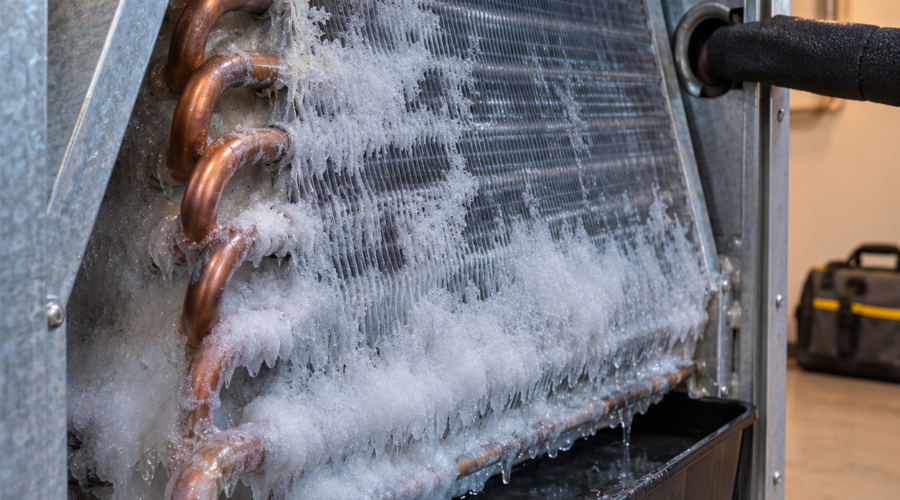
Ice on an indoor AC coil or refrigerant line is a sign to stop the cooling cycle and let the system be assessed. A clogged filter is one possible contributor, but a frozen coil can have several causes. Use the safe steps below, and do not keep running the AC or try to remove the ice yourself.

What a frozen AC coil can indicate
In cooling mode, the indoor evaporator coil absorbs heat from the home's air. If the coil becomes colder than intended, moisture can freeze on its surface. You may first notice ice on the refrigerant line near the indoor equipment or on an outdoor section of the line, weak airflow, water as ice melts, or air that no longer feels cool.
Restricted airflow, a blower or control problem, a dirty coil, or a refrigerant-circuit issue are among the possible causes. A photo or a single symptom cannot identify which one applies. For a separate guide to persistent operation without cooling, see what to check when an AC runs but does not cool.
Safe steps while the ice melts
- Keep the cooling mode off. A frozen coil can restrict airflow and may lead to more ice or water as it melts. Do not restart cooling while ice is still visible.
- Let the ice thaw on its own. Thawing time varies with the system and the amount of ice. Do not chip, scrape, bend, or pull at the coil or refrigerant line. Do not use a hair dryer, heat gun, hot water, or another heat source.
- Watch for meltwater from a safe distance. If water is leaking near electrical parts, spreading into a ceiling or wall, or overflowing around the indoor equipment, keep clear and contact a technician. Do not open a cabinet or reach into a drain pan.
- Check only the user-accessible filter and vents. Follow the equipment manual. If it explains how to replace the filter, keep the system off, use the specified size and type, and make sure return grilles and supply vents are not blocked. Our guide to choosing an HVAC filter explains why fit and airflow matter.
- Note what you see without touching equipment. Record where the ice appears, whether airflow changed, when the problem began, thermostat settings, recent filter changes, and any water or unusual sounds. A photo taken from a safe distance may help describe the condition.
What not to do
- Do not keep running the AC in cooling mode while the coil or line is frozen.
- Do not strike or scrape ice, pull on refrigerant tubing, or remove the equipment cover.
- Do not bypass a drain switch, open electrical compartments, or try to thaw the coil with a heat source.
- Do not add refrigerant or assume that low refrigerant is the cause. Refrigerant work and leak diagnosis belong to a qualified technician.
- Do not repeatedly reset a breaker that trips. Leave it off and arrange qualified service.
Changing a filter or clearing an unobstructed vent may address a simple airflow restriction, but it does not confirm the system is repaired. If ice returns, airflow remains weak, or you cannot identify a safe user-level issue, leave cooling off and request service before putting the system back into use.
When to call an HVAC professional
Arrange service when ice is substantial, appears again after thawing, or occurs with weak airflow, warm air, water leakage, unusual noises, or an AC that stops working. Call promptly if water is near electrical equipment, the system has damaged wiring, or a breaker trips. If there is smoke or an immediate fire risk, leave the area and contact emergency services.
A technician may inspect the filter and airflow, indoor blower, coil condition, thermostat and controls, condensate drain and safety switch, electrical components, and refrigerant circuit. Ask what the inspection will cover and whether the service provider handles your equipment type. Our checklist on questions to ask an AC repair contractor in New York can help you prepare.
Frequently asked questions
Should I turn off my AC if the coil is frozen?
Yes. Turn the system mode to Off at the thermostat and do not keep running cooling while ice remains. Use a fan-only setting only if your equipment manual explains it and there are no water or electrical safety concerns.
Can I chip the ice off the AC coil?
No. The coil and refrigerant tubing can be damaged easily. Let the ice thaw naturally, keep cooling off, and do not use tools, hot water, or a hair dryer.
Can a dirty air filter freeze an AC coil?
A loaded filter can restrict airflow and contribute to icing, but it is not the only possible cause. Replace a user-accessible filter only as the manual directs. If the coil freezes again or airflow does not recover, arrange professional diagnosis.
Can low refrigerant cause a frozen coil?
It can be one possible cause, often in connection with a leak, but ice alone does not prove that refrigerant is low. Do not open the sealed system or add refrigerant yourself; a qualified technician can test the system and explain the findings.
When can I turn the AC back on after it thaws?
Do not restart cooling until all visible ice has melted. If you do not know what caused the icing, if water leaked, or if the problem returns, leave cooling off and have the system checked before using it again.
This guide is general information, not a diagnosis of your equipment. Follow the manufacturer's instructions and use a qualified HVAC professional for electrical, refrigerant, or internal system work.