No products in the cart.
Heat pump systems
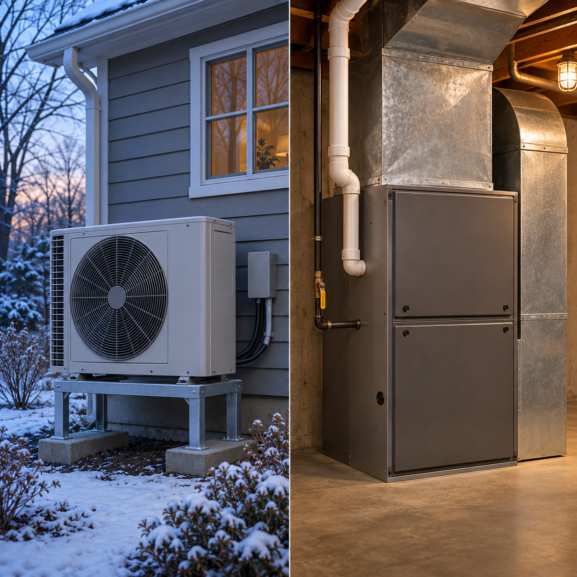
Air-source and ground-source heat pumps both use electricity to move heat, but they draw from different sources and require different work at the property. Compare the available space, site access, installation scope, equipment design, and operating assumptions before deciding which option is worth evaluating for your home.
How the two systems exchange heat
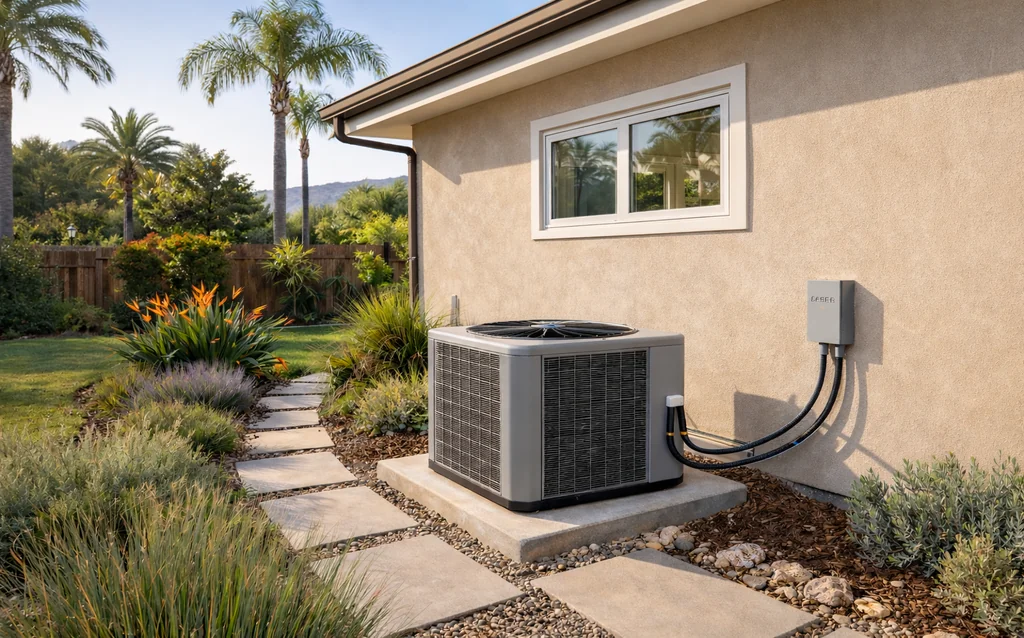
An air-source heat pump exchanges heat with outdoor air through an outdoor coil. In heating mode, it collects heat from the air and transfers it indoors; in cooling mode, it moves indoor heat outdoors. The outdoor unit, indoor equipment, controls, and any backup heat all form part of the system design.
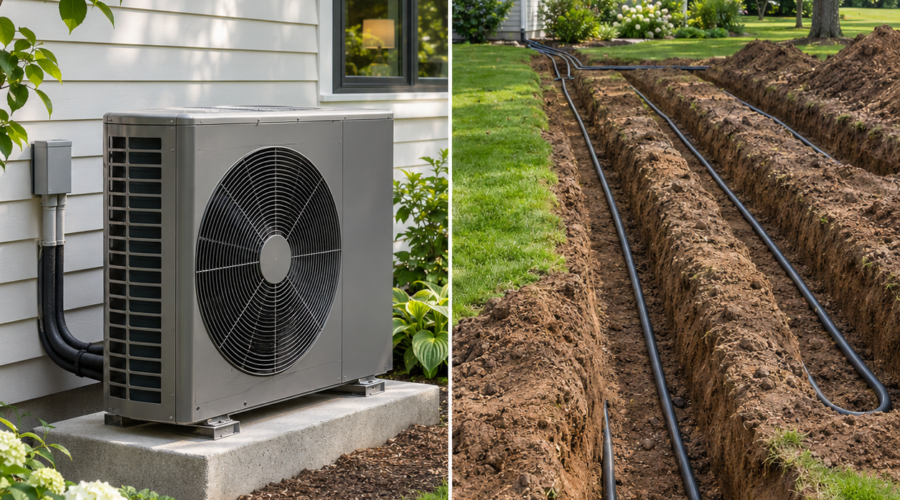
A ground-source heat pump, also called a geothermal heat pump, exchanges heat with the ground. Many residential systems use a closed loop of piping in horizontal trenches or vertical boreholes; other configurations may use groundwater where site conditions and local requirements allow. The indoor heat-pump equipment transfers heat between the source-side loop or water circuit and the home's distribution system.
Either type can be paired with different indoor distribution arrangements. Ask whether the proposal uses ducts, ductless indoor units, or another compatible system, and what changes are needed to serve the rooms. Our guide to ducted and ductless heat pumps in New York explains how distribution choices affect a project.
Compare the property work, not just the equipment
| Project factor | Air-source | Ground-source |
|---|---|---|
| Heat exchange | Uses an outdoor unit to exchange heat with outdoor air. | Often uses a buried closed loop; other site-appropriate configurations may be possible where permitted. |
| Space and access | Needs a suitable outdoor-unit location with clear airflow, service access, and a plan for snow and defrost water. | Needs room and access for trenching or drilling, loop installation, equipment delivery, and any required site restoration. |
| Installation work | May include electrical work, refrigerant lines, indoor equipment, controls, and duct or room-by-room distribution changes. | Includes the heat-pump equipment plus loop design and subsurface work. Ground conditions, utilities, and access can shape the scope. |
| Cold-weather questions | Ask for the model's capacity and performance at outdoor temperatures relevant to the home's design, and how backup heat is controlled. | Ask how the loop and heat pump are sized for the home's load, and what source-loop temperatures and operating assumptions the proposal uses. |
| Estimate details | Confirm outdoor-unit placement, indoor distribution, electrical scope, backup heat, permits, startup, and warranty coverage. | Confirm loop type and dimensions, drilling or excavation scope, permits, restoration, loop warranty, startup, and service responsibilities. |
Site conditions can change the installation plan
For an air-source system, the outdoor unit needs a location that meets the manufacturer's clearances and allows service access. Discuss snow drifting, roof runoff, drainage during defrost, sound near bedrooms or neighboring properties, and the path for electrical and refrigerant connections. Existing ducts should be inspected before a proposal assumes they can be reused.
For a ground-source system, ask how the contractor evaluated the proposed source configuration. Horizontal closed loops require trenching and enough suitable area; vertical loops can use less surface area but require drilling access and a plan for underground utilities, geology, permits, and restoration. If groundwater is part of the design, ask how water conditions, discharge or return arrangements, and applicable requirements are handled. A generic estimate may change after a site review.
Ask who designs and installs the loop, who coordinates excavation or drilling, and who is responsible for the heat-pump equipment and controls. The written proposal should explain the division of work and the warranties for both the indoor equipment and buried loop.
Compare the full installed cost
Ground-source projects can involve substantial drilling or excavation in addition to indoor equipment, so their initial project scope may be larger than an air-source installation. The difference varies with the property, loop design, equipment, distribution work, local labor, and site restoration. Avoid treating a broad cost range or a single equipment price as a quote for your home.
For either system, compare the same items: load calculation, model numbers, indoor distribution, electrical work, permits, controls, backup heat, commissioning, warranties, and exclusions. For ground-source estimates, ask that loop design and subsurface work be itemized. For air-source estimates, ask that cold-weather capacity and any duct or electrical changes be clear.
Projected running cost also depends on the utility rate, system performance, weather, household settings, and backup-heat use. Our article on factors that affect heat-pump operating cost explains which assumptions to compare. For a broader checklist, see questions to ask about heat-pump sizing and estimates.
Operating performance depends on the design
An air-source heat pump works with changing outdoor-air temperatures. Its heating capacity and efficiency vary by model and conditions, and defrost cycles or backup heat can affect operation. Cold-climate models are available, but compare published performance at temperatures that matter for your area rather than relying only on a general label. See what to expect when a heat pump runs in cold weather.
Ground-source systems use the ground as their heat-exchange source, whose temperatures are generally less exposed to short-term outdoor-air swings. That does not guarantee a lower bill or a better result in every home. Loop design, pump energy, equipment selection, distribution, controls, utility rates, and installation quality all affect actual performance.
For a fair comparison, ask each contractor for the assumptions behind its seasonal energy estimate, including local rates, backup heat, heating and cooling loads, and the equipment's operating data. Compare similar scopes and ask what could make real usage differ from the projection. If you are also weighing a furnace, our New York heat-pump vs. furnace guide covers additional factors without prescribing one system for every home.
Questions to ask before choosing a proposal
- How was the home's heating and cooling load calculated, and what rooms or zones will the design serve?
- For an air-source system, what heating capacity does this model provide at the local outdoor design temperature, and when can backup heat operate?
- For a ground-source system, is the design closed-loop or another configuration, and what site information supports it?
- Which electrical, duct, indoor distribution, trenching or drilling, permit, and restoration costs are included or excluded?
- Who is responsible for design, installation, commissioning, and service of each part of the system?
- What assumptions were used for annual energy use, utility prices, and backup heat, and can the estimate show a range?
- Which warranties apply to the heat-pump equipment, controls, workmanship, and buried loop?
Use the answers to understand the tradeoffs for your property. A site-specific design and a complete written scope make it easier to compare two different systems without assuming one is automatically the right choice.
Frequently asked questions
Is a ground-source heat pump always more efficient than an air-source heat pump?
No. Ground temperatures are generally more stable than outdoor air, but actual performance depends on loop design, equipment, distribution, controls, and installation. Compare model-specific and site-specific assumptions rather than relying on a general efficiency claim.
Does a ground-source heat pump need a large yard?
Not always. Horizontal loops need suitable area for trenching, while vertical boreholes can reduce the surface footprint but require drilling access and site review. Other source configurations may be considered where conditions and local requirements allow. A contractor can assess what is feasible for the property.
Can an air-source heat pump heat a home in a New York winter?
Some cold-climate models are designed for low outdoor temperatures, but capacity and efficiency vary by model and conditions. Ask for performance at local design temperatures and an explanation of the backup-heat plan.
Which type has the lower lifetime cost?
There is no universal answer. Compare installed cost, energy-use assumptions, local rates, maintenance, warranties, expected system life, and any current incentives that apply to your address.